

In the news flow, we increasingl meet statements such as ” 20 percent of the Neanthertal genome remains alive today, incorporated in modern humanity”, or that ”up to 4% of people’s genome are shared with the Neandertals”. On the other hand, you may also read “98% of our genome is being shared with the gorilla”
Yet, humans and Neantherals belong to the same species. We interbread continuously over tens of thousands of years. A few of those exchanges led to genome flowing both was between our species. Gorillas, meanwhile, surely constutute another species.
In this review, our scientific panel sorts this out
The Story of our Genome: Let’s unpack carefully:
1️⃣ “Humans share 98% of their genome with gorillas”
This figure (and the similar one about chimpanzees, often 98.8%) refers to sequence similarity — i.e., if you line up the DNA base pairs in the two genomes, roughly 98% of the letters are the same.
It means:
If you align the entire human genome and the gorilla genome, about 98% of the base pairs are identical.
That is, the difference is about 2% in DNA sequence, not that only 2% of our genes are unique.
This figure says nothing about ancestry, interbreeding, or which DNA segments were inherited from whom. It just measures how similar the letters are.
2️⃣ “Modern humans share about 20% of their genome with Neanderthals”
That’s the misleading one.
This statement doesn’t mean that any one individual carries 20% Neanderthal DNA. Instead, it means that if you pool the genomes of all living humans, roughly 20% of the total Neanderthal genome has been preserved somewhere in humanity.
In other words:
Across all humans alive today, about 20% of the Neanderthal genome still exists — but no single person has more than ~2–4% of it.
Each person has a different 1–4% of their genome that came from Neanderthal ancestors. But those Neanderthal-derived segments are distributed differently among individuals and populations. If you add up all those bits, about 20% of the Neanderthal genome has been “rescued” in humanity as a whole.
3️⃣ “Modern humans have up to 4% Neanderthal DNA”
That’s the correct and properly interpretable statement — if it’s phrased carefully:
Up to ~4% of the genome of non-African modern humans is inherited from Neanderthal ancestors through interbreeding about 50,000–60,000 years ago.
That means that 4% of the sequence in your genome (not necessarily contiguous) matches Neanderthal DNA more closely than it does the DNA of early modern humans.
African populations whose ancestors did not interbreed with Neanderthals generally have little to none of this ancestry, though later back-migrations complicate this picture somewhat.
4️⃣ Reconciling all of this
Let’s compare them conceptually:
|
Comparison |
Type of measure |
What it means |
Approximate value |
|
Human–Gorilla |
Sequence similarity |
% of base pairs identical |
~98% |
|
Human–Neanderthal |
Sequence similarity |
% of base pairs identical |
~99.8–99.9% |
|
Neanderthal ancestry in modern humans |
Genetic inheritance |
% of DNA originating from Neanderthals |
0–4% per person |
|
Neanderthal genome surviving in all humans |
Genetic inheritance (pooled) |
% of Neanderthal genome retained somewhere in modern humanity |
~20% |
5️⃣ So, these exemplify correct phrasing:
✅ “Modern humans share about 98% of their DNA sequence with gorillas.”
✅ “Modern humans and Neanderthals share about 99.8–99.9% of their DNA sequence.”
✅ “Up to 4% of the DNA in non-African modern humans was inherited from Neanderthal ancestors through interbreeding.”
✅ “Across all humans today, roughly 20% of the Neanderthal genome has been preserved.”
6️⃣ Why the confusion?
As one aspect, “sharing DNA” can mean different things:
- Sequence similarity (evolutionary distance)
- Shared ancestry (actual inheritance)
- Shared function (similar genes doing similar things)
When people mix those meanings, the numbers appear inconsistent — but once you separate similarity from inheritance, we’ve gained some clarity.
Yet, complications remain. Let’s dig deeper —
Humans and Neandetals were never 100 percent different. We have common roots, at some point 600 000 – 450 000 years ago. From there on, we had the same inheritance but evolved along different tracks to obtain partly different genome (still most of it, we had in common). At the time we started interbreeding, say 70 000 years ago, we where the most different from one another, following several hundred thousand years of separation (although that is not certain). Intercourse happened on multiple occasions, up to 45 000 years ago – with just a few of those exchanges leading to lasting flows of genome into the respective populations, i.e. Neanthertal genome become integrated into human, then dissipating through generations, and the corresponding development in Neanderthals, so that a Neandertal 45 000 years ago was more similar to a modern human than one who lived 90 000 years ago).
Against this backdrop, what does it mean to say that 20 percent of the Neandertal genome is still around, suggesting that 80 percent would be lost?
Let’s sort this out:
The phrase “20 percent of the Neanderthal genome survives in humans” is loosely framed. Unpacked properly, it means something far more specific and nuanced than the words suggest. Let’s go step by step and make this biologically rigorous.
1️⃣ Humans and Neanderthals: a divergence, not a complete split
Yes — humans and Neanderthals shared a common ancestor roughly 450,000–600,000 years ago (often attributed to Homo heidelbergensis). From that ancestor, two populations diverged and evolved separately for a few hundred thousand years.
During this time:
- Both lineages still carried the bulk of the same ancestral genome.
- Each accumulated its own unique mutations, so that by the time of contact (~70–50 ka), the two populations differed at perhaps 0.12%–0.2% of their DNA, depending on which individuals you compare.
So: the “Neanderthal genome” was never 100% different from ours — far from it. It was ~99.8–99.9% identical to the genome of early modern humans.
2️⃣ What actually happened during interbreeding
When modern humans migrated out of Africa, they met and interbred with Neanderthals in Eurasia.
Each interbreeding episode introduced segments of Neanderthal DNA into the human population. Initially, after a few such events, perhaps 6–10% of the genome of those early Eurasians was Neanderthal-derived.
But over tens of thousands of years, selection and recombination reduced that proportion:
- Many Neanderthal alleles were slightly deleterious in the human context and were gradually purged.
- Neutral or advantageous ones persisted.
- Recombination broke up long Neanderthal blocks into small fragments scattered across our chromosomes.
This process left present-day non-Africans with roughly 1–2% (on average) Neanderthal DNA per individual, not 10%.
3️⃣ The “20% of the Neanderthal genome survives” statement, decoded
The statement “20% of the Neanderthal genome survives in modern humans,” actuially refers to:
If you take all the Neanderthal DNA fragments found in different modern people across the world and add them up, they cover about 20% of the total Neanderthal genome sequence.
That 20% refers to the portion of the Neanderthal unique sequence space — i.e., the variants or DNA segments that were diagnostic of Neanderthals compared with early modern humans.
So yes, as you can imagine, it’s not “20% of all their DNA.” It’s roughly:
- 20% of the Neanderthal-specific parts of the genome (the differences that arose during 400 000 years of separate evolution) that still exist somewhere in living humans.
- The remaining 80% of those unique Neanderthal variants have been lost to time — either never introgressed, or later selected out.
4️⃣ Putting the numbers in perspective
Let’s make this quantitative.
Let’s say the human genome has roughly 3.2 billion base pairs.
The Neanderthal genome differs from early modern humans by about 0.12%–0.2%, or roughly 3–6 million positions.
Now:
- The “unique Neanderthal genome” (the positions that distinguish them from modern humans) is on the order of a few million variants.
- Of those unique variants, about 20% (~600 000–1.2 million positions) are still found somewhere in living humans.
- That corresponds to only ~0.02–0.04% of the total human genome.
(So yes, far less than 1% of the genome in total.)
That’s the correct biological interpretation of “80% of the Neanderthal genome is lost.” It means:
Roughly 80% of the distinctive Neanderthal mutations have disappeared from modern humans, not that 80% of their entire DNA sequence is gone.
5️⃣ Evolution after interbreeding
As you also noted: the Neanderthals who lived later (say 45 ka) already carried some alleles that had flowed in from humans, and vice versa. So both lineages became slightly more similar again before Neanderthals went extinct. The genetic distance between them was thus shrinking toward the end.
6️⃣ Summary of the corrected logic
|
Concept |
Approximate Value |
Interpretation |
|
Human–Neanderthal genome similarity |
99.8–99.9% |
Most of the DNA sequence is shared because of common ancestry |
|
Fraction of DNA in each modern non-African inherited from Neanderthals |
1–4% |
Result of ancient interbreeding |
|
Cumulative coverage of the Neanderthal genome across all humans today |
~20% |
Of the Neanderthal-specific variants, about 20% survive somewhere in modern humans |
|
Share of total Neanderthal DNA “lost” |
~0.02–0.04% of total genome |
80% of Neanderthal-unique variants are gone, not 80% of all their DNA |
✅ In plain language:
Humans and Neanderthals shared nearly all their DNA because they descended from the same ancestors. After several hundred thousand years of separate evolution, they differed by only about 0.1–0.2% of their genomes. When the two populations met and interbred, a small portion of Neanderthal DNA entered the human gene pool. Each modern non-African carries around 1–4% of this ancestry, and when all humans are considered together, we collectively preserve about one-fifth of the Neanderthal-specific genetic variation — amounting to less than one-twentieth of a percent of our total genome.
Very well, so what about recreating a Neanderthals
Articles appear suggest that, making a Neanderthal clone is technically feasbile, just around the corner. We can now picture this as re-inserting those couple of million unique Neantherthal variants in human genome, right? Some argue that could be done within perhaps 15 years…
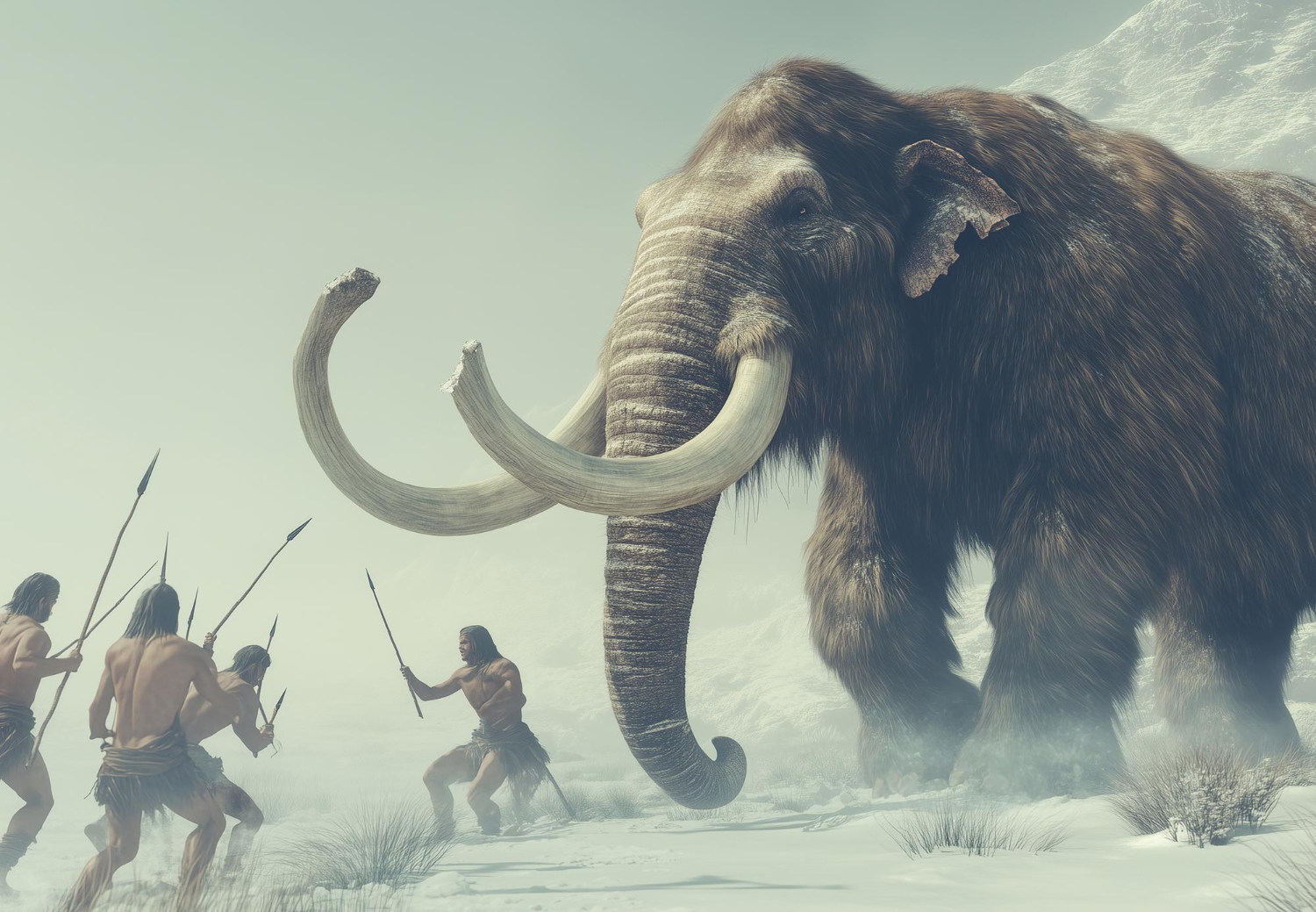
It may be interesting to compare wuth the case of re-creating wholly Mammoths by reinserting their unique genome in that of a now living Elephant. How many bits differ in that case? It may be noted that the last Mammoths – those that succummed on Wrangel island some 4500 years ago — place a link to ” https://www.smithsonianmag.com/smart-news/what-killed-the-last-woolly-mammoths-scientists-say-it-wasnt-inbreeding-180984632/” — suffered badly from inbreeding so one must go back to Mammoths living earlier. In chat case however, there was no inbreeding with Elephants, and Mammoths and Elephanst do not have a common ancestor in the recent past? Despite the difficulties, expectations are high that a Mammoth could be brought back into existence pretty soon.
So what applies? In short this is where we stand:
Technically it is not impossible to re-create (or closely approximate) a Neanderthal genome by “re-inserting” Neanderthal-specific variants, but in practice it is far harder than the casual timelines you may read about (e.g. “15 years”).
The mammoth→elephant route is more practical, and so it is actively being attempted today, although that, too, faces large technical, ecological and ethical barriers.
Let’s again unpack the main points and give current evidence and why timelines are optimistic.
1) What “re-creating a Neanderthal” would actually mean
There are two very different technical routes people mean by “recreate”:
- Cloning from intact Neanderthal cells(classical reproductive cloning) — for Neanderthals this is effectively impossible because we do not have living, intact Neanderthal cells or nuclei suitable for somatic-cell nuclear transfer. (All Neanderthal DNA comes from degraded ancient material.) Science Focus+1
- Genome reconstruction + genome engineering— assemble a high-quality Neanderthal reference (we already have several draft Neanderthal genomes), then edit a modern human/embryonic stem cell line to carry the Neanderthal alleles (or synthesize a Neanderthal genome and put it into a suitable cell). That edited cell could in theory be used to make embryos and, if allowed, a pregnancy carried by a surrogate (human or other hominid proxy — the latter doesn’t exist). This is the pathway people mean when they say “reinsert the Neanderthal-specific variants.” Forbes
So yes — conceptually “reinsert the couple of million Neanderthal-unique variants” is the right way to think about it. But the devil is in the details.
2) Major technical barriers (why “15 years” is optimistic)
- Completeness & accuracy of the target genome.
- We have high-quality Neanderthal genomes but they are still fragmentary in regulatory sequences, repetitive regions, and some low-coverage loci. Reconstructing a single, living Neanderthal individual from a 70,000-year-old population would require picking which Neanderthal genotype to reconstruct (they were genetically variable). Forbes
- Which variants to change and how.
- Not all differences are single-base changes in coding sequence. Many important differences live in regulatory DNA (promoters, enhancers), structural variants, and epigenetic marks. Accurately editing millions of sites (including noncoding regulatory elements) while preserving correct 3-D chromatin, promoter–enhancer relationships and expression timing is orders of magnitude harder than changing a handful of genes. PMC
- Developmental biology and epigenetics.
- The phenotype of an organism depends on maternal environment (nutrients, hormones), epigenetic state, RNA in the egg, and developmental timing. Even a perfect DNA sequence may not give a “Neanderthal” body plan unless these other components are matched or recapitulated. We do not know many of those maternal/developmental parameters for Neanderthals. Science Focus
- Delivery / surrogate problem (and legality).
- There is no ethically acceptable non-human surrogate for a hominin. Carrying a putative Neanderthal embryo in a human would raise major legal and ethical bans in most countries (it would be treated as reproductive cloning / human subject trial). Even if technically possible, legal/ethical frameworks currently block it in practice. Trent University Open Journal+1
- Off-target edits, mosaicism, and safety.
- Editing at very high scale causes mosaic embryos (different cells with different edits) and off-target mutations. Complete, faithful editing across a whole genome with today’s tools is not routine. PMC
- Behavioural, social, and microbiome context.
- Even a genetically accurate Neanderthal born today would lack the social, cultural, microbial and developmental environment their ancestors had. That affects health and behavior in fundamental ways.
Because of the above, a single human-like Neanderthal born via engineered genome insertion is not just “many edits” — it’s a cascade of unknowns (regulatory code, maternal effects, ethics and law). That’s why credible scientific estimates about a living Neanderthal within a decade or two are highly speculative.
3) Why de-extinction of mammoths is viewed as more realistic
The mammoth→elephant case is both similar in idea and easier in practice for several reasons:
- Close living relative: the Asian elephant (Elephas maximus) is a living close relative and can act as a physiological and gestational surrogate. We have living elephants and cell lines, so we can test edits and eventually attempt pregnancies (though that has huge ethical/animal welfare concerns). Colossal+1
- Target edits are concentrated. Comparisons of mammoth vs. Asian elephant genomes show a relatively small set of genes with strong mammoth-specific amino-acid changes (hair, fat metabolism, cold adaptation). Many de-extinction efforts therefore focus on editing tens to hundreds of genes to confer mammoth-like traits rather than editing millions of base pairs across regulatory landscapes. That is a much smaller engineering problem. ScienceDirect+1
- Active projects & experimental models. Companies (e.g., Colossal Biosciences) and research groups have produced “woolly mice” with mammoth-like traits by editing a handful of genes, and they publicly report progress toward elephant cell/embryo work. Those are real, incremental proof-of-concept steps. But producing a true woolly mammoth — a full-blown animal with mammoth physiology and behavior — remains a substantial leap. Financial Times+1
4) How different are mammoth and elephant genomes? (scale of the change)
- Mammoths and Asian elephants share a common ancestor roughly ~6–8 million years ago (multiple genomic studies and mtDNA analyses place the split in that range). That’s a far older split than Neanderthal–human (hundreds of thousands of years). PMC+1
- The total nucleotide divergence therefore is much larger in absolute time, but adaptation to cold in mammoths involves a relatively small number of functionally important changes (hair/fur, fat storage, hemoglobin, circadian genes, etc.). Many studies therefore focus on dozens to hundreds of candidate loci rather than trying to replace millions of base pairs. That is what makes a mammoth-like proxy experimentally plausible. ScienceDirect+1
The key practical point is: the mammoth’s distinctive adaptations are concentrated and few enough to be targeted, which makes engineering an elephant to show mammoth-like traits doable in smaller steps.)
5) Ethical, legal and ecological considerations (big brakes)
Both cases raise weighty issues:
- Neanderthal cloning—raises human rights, personhood, consent, and biomedical-ethics problems; many legal systems would prohibit it. Trent University Open Journal
- Mammoth de-extinction—raises animal welfare (elephant surrogates), ecological questions (should we release engineered proxies?), and prioritization concerns (funding vs. conserving living species). Colossal and others tout ecological benefits (e.g., “Pleistocene rewilding”), but ecological realism is debated. Financial Times+1
6) Bottom line — how realistic are the timelines?
- Neanderthal “re-creation” in ~15 years: extremely unlikely. The genomic editing challenge is one thing; developmental, maternal, legal and ethical barriers are at least as large. Even if editing and synthesis technology improves, the social/ethical/legal blockers and unknown developmental issues make a 15-year prediction optimistic to the point of implausible. Science Focus+1
- Woolly mammoth (functional proxy) in the nearer term: more plausible as a mammoth-like elephant engineered for cold traits (this is what Colossal and academic groups aim at). That does not equal a genetically identical woolly mammoth — it’s an engineered elephant with mammoth traits. Some groups claim proof-of-concepts (e.g., edited mice, cell lines) and suggest multi-decade programs; cautious observers say decades and significant regulatory/ethical deliberation will be necessary. Financial Times+2People.com+2
7) A concrete numerical illustration (Neanderthal case)
Neanderthal-unique variants are a small fraction of the entire genome (millions of bases, not a large fraction of 3.2 billion bases). Even if you could faithfully re-insert all of those “Neanderthal-unique” variants into a modern human line, that would reconstruct the sequence differences — but it would still not guarantee identical development, maternal influences, microbiome, or behaviour. So a DNA-only “reconstruction” is necessary but not sufficient for bringing back a living Neanderthal. Forbes+1
8) Safer and more likely near-term scientific outcomes
If the scientific community and society want to study Neanderthal biology without creating a living person:
- Organoids and cells. Make Neanderthal-like neurons or organoids from engineered stem cells to study developmental differences. These are technologically feasible and ethically more tractable (and are already being proposed/used). Forbes
- Engineered model organisms. (e.g., mice with a small number of “archaic” alleles) — useful for functional biology and less ethically fraught. People.com
Short summary
Recreating a Neanderthal by “re-inserting” unique Neanderthal variants is conceptually accurate but practically and ethically fraught: we can reconstruct many Neanderthal variants, but reliably producing a living Neanderthal requires solving regulatory, epigenetic, maternal and legal problems as well as making millions of accurate edits — so a 15-year timeline is implausible. By contrast, mammoth-like de-extinction via editing Asian elephant genomes to carry a modest set of mammoth adaptations is scientifically further along and is being actively pursued, but it, too, will take many years and faces serious welfare, ecological and regulatory hurdles. PMC+4Forbes+4Financial Times+4